
Most businesses treat their wireless network like a utility — install it once and hope it keeps working. That approach costs you in dropped calls, failed video conferences, slow file transfers, and employees routing around the network instead of through it. By the time you notice a problem, your people have already been working around it for weeks.
Triton delivers managed Wi‑Fi services that put your wireless infrastructure in the hands of a team that monitors and maintains it every day. We handle access point provisioning, firmware updates, performance tuning, security policy enforcement, and proactive issue resolution — all as an ongoing managed service. You get enterprise-grade reliability without adding IT headcount or managing vendors yourself.
Whether you operate a single office in Worcester, a multi-location practice across Massachusetts and Rhode Island, or a distributed team spanning Connecticut and New York, Triton scales with you. Independently verified response times averaging under 10 minutes — benchmarked against thousands of MSPs nationally.
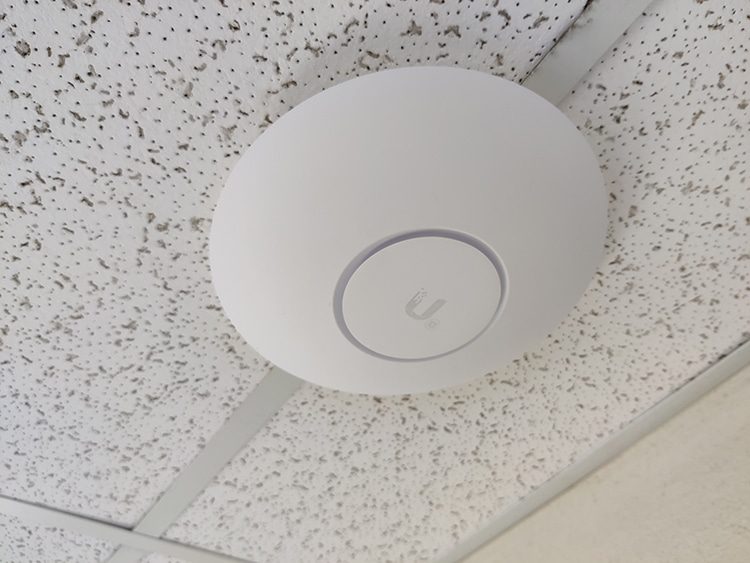

Consumer-grade routers and prosumer access points were not designed for the demands of a real business environment. Device density, concurrent connections, VLAN segmentation, traffic prioritization, and security policy enforcement all require purpose-built enterprise hardware. Triton deploys and manages infrastructure from Cisco Meraki and HPE Aruba — the platforms organizations trust when wireless failure is not an option.
Both platforms are fully cloud-managed, meaning every access point, switch, and security policy is configured, monitored, and updated from a centralized dashboard. Firmware pushes happen automatically. Anomalies trigger alerts before they become outages. Performance metrics are tracked in real time so we can identify degradation before your users do.
Every Triton deployment is scoped to your actual environment — floor plan, ceiling height, wall materials, device count, and bandwidth requirements all factored before a single access point is mounted. You get a wireless network designed to perform, not one sized by guesswork.
Weak signal and dead zones are not always obvious until a client walks into your conference room and can’t connect, or your warehouse floor loses scan guns mid-shift. Professional wireless network management starts with knowing exactly where your signal is strong, where it fades, and why — before your users tell you there’s a problem.
Triton uses enterprise-grade heat mapping tools to survey your space and produce a detailed picture of signal strength, channel interference, access point overlap, and coverage gaps. We analyze your building layout against your actual usage patterns — where people work, where devices connect, where bandwidth demand peaks. The result is an access point placement plan that eliminates dead zones and maximizes performance across every square foot.
Post-deployment, we validate coverage against the original survey to confirm every area meets performance thresholds. As your team grows and your space evolves, ongoing wireless network management catches performance drift and corrects it before it affects your business.


Running employees and guests on the same wireless network is one of the most common — and most avoidable — security mistakes in small business IT. A guest on your network can reach internal file shares, printers, and connected devices. In a regulated industry, that exposure is not just a risk — it’s a compliance violation.
HIPAA requires that protected health information be isolated from general network traffic. PCI DSS requires cardholder data environments to be segmented from everything else. Massachusetts businesses also face 201 CMR 17.00 data security requirements that include wireless access controls. Triton designs your wireless architecture to satisfy these requirements from the ground up — not as an afterthought.
We configure dedicated guest SSIDs with captive portal authentication, enforce user-level access policies, implement VLAN segmentation to isolate traffic, and produce the documentation your compliance audits require. Whether you’re a healthcare practice in Worcester, a financial services firm in Providence, or a law office in Hartford, your wireless network is part of your compliance posture — and Triton treats it that way.
We assist law firms in finding the products, services and cost-control infrastructure that allow lawyers to better collaborate with clients and peers while meeting needed security and standards.
“Triton transformed our office connectivity. We went from constant complaints about dropped connections to a network that just works — across all three of our locations. Response time when we have an issue is measured in minutes, not days.”
Matt
Managing Partner, Financial Asset Management Firm
“Our HIPAA compliance requirements made network segmentation non-negotiable. Triton understood that from the first conversation — they designed our wireless environment with compliance built in, not bolted on. That’s made audit prep significantly simpler.”
David
IT End User Services Manager, Regional Health Insurance Provider
+ What is a managed Wi‑Fi service and why does my business need one?
A managed Wi‑Fi service means your wireless network is designed, deployed, monitored, and maintained by a dedicated IT provider — not left to an internal employee who also handles every other IT issue. Triton handles access point configuration, firmware updates, performance monitoring, and troubleshooting as an ongoing service. Wireless infrastructure degrades over time, firmware vulnerabilities emerge, and device density increases — all of which require active management to keep your network secure and performing.
+ What’s the difference between consumer Wi‑Fi and a business wireless solution?
Consumer routers are designed for a household with a handful of devices and casual usage. A business wireless solution uses enterprise-grade access points from Cisco Meraki or HPE Aruba — hardware engineered for high device density, concurrent connections, VLAN segmentation, traffic prioritization, and consistent uptime. Enterprise hardware also supports the compliance architecture that regulated industries require. The difference in performance, security, and reliability is not incremental. It is fundamental.
+ How do I know if my current wireless network needs to be replaced or upgraded?
Common indicators: dropped connections, slow speeds in specific areas, inability to support your current device count, employees and guests sharing one network, access points older than five years, or a pattern of Wi‑Fi-related help desk tickets. Any one of these is a signal. More than one means your wireless infrastructure is actively costing you productivity. Triton offers professional wireless assessments that diagnose exactly what is wrong and what it will take to fix it.
+ Can Triton manage Wi‑Fi across multiple office locations?
Yes. Triton manages multi-site wireless environments across Massachusetts, Rhode Island, Connecticut, and New York from a single cloud-managed platform. Each location is configured and monitored independently, with centralized visibility across all sites. When an access point goes offline or performance degrades at any location, our team sees it and responds — typically before your users notice.
+ Does managed Wi‑Fi help with HIPAA, PCI DSS, and other compliance requirements?
Yes, and it is often required. HIPAA mandates isolation of protected health information from general network traffic. PCI DSS requires cardholder data environments to be separated from other systems. Massachusetts 201 CMR 17.00 requires wireless access controls as part of reasonable technical safeguards. Triton designs wireless environments that meet these standards — guest network isolation, VLAN segmentation, encrypted traffic policies, user access controls, and audit-ready documentation. If your business handles regulated data, your wireless network is part of your compliance posture. Triton builds it that way from day one.
Founded 2001
25 Years
Microsoft Partner
AWS Partner
HIPAA · CMMC
SOC 2 · PCI DSS
Under 10-Min Response
Third-Party Verified
Serving MA · RI · CT · NY
and Internationally
Slow Wi‑Fi, dead zones, and unsegmented networks are problems Triton solves every day for businesses across Massachusetts, Rhode Island, and Connecticut. Contact us to schedule a wireless assessment.